Wednesday, October 26, 2016

God Does Not Have a Wonderful Plan for Your Life. Sorry.

A lot of well-meaning but sadly confused religious folk have been walking around thinking this:

God has a wonderful plan for your life.

And our cartoonist from the last blog post has been suckered in by this, as follows:

Our lives are predetermined, so it's not our fault if we do crappy things to each other, and so hell isn't really fair.


That is, God has this wonderful plan, but we, um, aren't interested since sex, drugs and rock&roll are so much more fun (or partying or getting drunk or being a hedgefund manager or a dictator or a serial killer or a rapist or a drug dealer or just your garden variety very nice kind to others giving and generous atheist), so we miss the plan and go to hell. Dang. Doesn't seem right. The last one, I mean.

But our religious folk are confused.

God does not have a wonderful plan for your life.

Your life is not predetermined by God.

Nobody's is.


You get to make decisions. And the decisions add up to being the life you create.

You can make God-ish decisions. Feed the hungry. Care for the homeless. Fight injustice and oppression. Don't be a jerk.

Or you can make not-God-ish decisions. Pretty much the opposite of all of those. Basically, be a jerk.

Religious folks somehow got the idea somewhere along the way that God had everyone's life entirely planned out, start to finish, and you just had to figure out what his plan for you was, and then all would be peachy.

Only he doesn't tell you what the plan is.

Which is kinda nasty.

So you have to guess a lot and hope for the best. And pray. There's lots of praying.

So, the assumption goes, every minute is planned out. And you have to guess right. And he's not telling.


That's not the way it works. Nothing is predetermined. Nothing is planned out. Things might go well. They might go really really badly.

But. Regardless of what choices you make in your life, you're supposed to do the same thing all along the way.

Don't be a jerk. Love God. Love your neighbor. Be nice.

Now. Since God is God (if he exists) and can do anything he wants, he surely might have a plan for someone every now and then. There are examples.

But for most of us, and when I say most, I mean statistically pretty close to all of us, there's one plan.

Live your life. Make good choices. Do the right thing. Don't be a jerk.

That's free will. Take whatever job you want. Marry whomever you want. Live wherever you want. Do whatever you want to do. Live your life. Make good choices. Do the right thing. Don't be a jerk.


Here's what I'm telling you. God doesn't have a job, a spouse, a house, or anything else planned out for you. I'm not saying he doesn't care, but it's not planned and waiting for you.

You get to choose. It's a free will thing.

If you assume that God has planned it all out, and all you have to do is figure it out via prayer and fasting, then there would be, it seems to me, only two types of decisions.

Perfect ones.

Crappy ones.

That's it.

But life doesn't work that way.

Because there are no perfect choices.

Jobs - every job is going to be crappy at some point or another.

Spouses - every spouse is imperfect, and that includes both sides of the spouse coin.


Living here, living there - there are no perfect places to live, and I'm a good source, because I've lived in Zurich, Geneva, Pebble Beach, Monterey, and Colorado, which are pretty danged spectacular places to live.

But not perfect. Spectacularly not perfect, in fact.

Maybe you think God wants you to go to Africa or the inner city or China.

It would surely be fine for you to go there and do whatever it is you think that you are supposed to do.
No offense.

But there stands an excellent chance that it will surely not be perfect when you get there.

You'll be lonely. Bored. Lusty. Frustrated. Scared. You'll hate the locals and the local culture at some point, maybe at all points.

And if you think that you might not have done better to have stayed where you were, well, you easily might have.

Going, staying. Either is fine. Either is a good decision. Both come with good, bad and ugly parts.


It may be that the only real free will decision you get to make is kind of Hamlet-y. To be a jerk or not to be a jerk. Wherever you are and whatever you do.

That's worth thinking about.

BTW, I think it's useful to make the more challenging choice sometimes. Pain and suffering are good for you. Up to a point.

Tuesday, October 11, 2016

Now It Gets Confusing

So. Here's what we are saying.


In a universe with a starting point where things are not always predetermined (because of quantum uncertainty) or predictable (because of Chaos Theory and the Butterfly Effect), then it is possible that both God and Free Will exist.

That's because thinking types back in the 18th Century said that if the universe is predetermined by the laws of physics and totally predictable and infinitely old, then 

1) you don't need God to do anything and 

2) you can't have free will. 

The laws of physics make everything happen, they've always been there, nobody made them, nobody made anything, and they make you do everything you do.

But since the universe is not infinitely old and the laws have not always been there because they came into existence with Big Bang, and quantum uncertainty is the Way Things Work, then 

1) you might need God to make everything happen and 

2) you might have free will.

Nice. God and Free Will got thrown out together, so they get to come back together. Sweet.

However. There are some skeptical types who say things like this:


If God already knows everything that's going to happen, then you can't have free will, since he already knows what you are going to do.

That is...

if God exists, then free will can't.

Or, if God exists, then HE predetermines everything, not the laws of physics.

Hm. That is a problem.

Because now we're in a place where free will only exists if God exists, but if God exists, then free will can't.

That cartoon right there says it just like some folks want it to be said.

So what you gotta do is look at assumptions and conclusions and see if they are good physics. Since if God exists, he made physics that way that it is.

Here we go.

"If God knows the future"

OK, that works. If God exists, he made space and time (which bounced into existence with Big Bang, so that's good physics). If he made space and time, then wherever or whenever he exists, it's not in space and time. He's outside of space and time. 

(Make sure you get this part. God doesn't exist in a where or a when. He does not occupy a point in space and/or time.

(That's the way we [who exist in points in space and time until we don't exist anymore] understand existence.

(So if someone asks the question, does God exist?, the answer is, what do you mean by existence?

(If he exists, he does not exist in the same way that we do. He created the way that we exist.)

Anyway.

Since he's God (if he exists), then, well, he's God, and he can see all of space and time together. Now since to a photon traveling at the speed of light, all of space and time are one point, then clearly God is at least as cool as a photon, so since he can see all of space and time, then he knows the past, the present and the future all at once. He sees it all. But not like a movie that he has already watched. Everything is a point to God, so he sees it all at once.

That's just physics.

"The future must already be determined, and if the future is already determined, we have no control over our future actions."


You wanna take a shot at this one? Go ahead. I'll wait.

(clock ticking. background humming. toe tapping. very large claw tapping.)

Time's up. Let's see how you did.

Problem the first: our cartoonist, and all the thinkers and philosophers who derived their thinking and philosophy from this cartoon (or maybe vice versa), is/are fooled by time. S/he isn't thinking about God outside of time, but God inside of time, as though the place God hangs out is just like the time and place we hang out, and, well,

it isn't.

We don't know what it is, but it's not time and space the way that we experience it.

So trying to catch God in a space-time trap isn't gonna work.

Problem the second: our cartoonist et al is blissfully unaware that this universe, the universe that if God exists and created it, is quantum. And it's chaotic.

And thus, nothing is predetermined. None of our lives, our decisions, our actions, anything we do is predetermined by anything except maybe behavioral conditioning, and we don't know where that starts and stops.

And that's the way God made it, because 1) if he exists 2) he made it and 3) intended for us to find it 4) the way that it is.

Now you might say, as my atheist friend Trevor once said, well, just because we can't know all of the forces that cause things to happen chaotically, doesn't mean that they can't be known by someone (in a God-like sort of way). And thus, things are predictable.

To which I responded, those forces might be capable of being known, but they get smaller and smaller until they become quantum, and then

they cannot be known anymore, because at the quantum level, nothing is predetermined. Ultimately, everything is quantum, and nothing is predetermined.


So here's the answer. God knows what you are going to do. No, that's not right. God knows what you did, what all of us did, because he sees all of time at once. But what you are going to do is not predetermined and is up to you. He sees the beginning and the middle and end game all at once. But you get to ride the ride and make the decisions yourself.

If you like, it's a quantum thing. He both knows and does not know, depending upon how he is looking. It's all in the observation. And you, as the observer yourself, have a choice to do, or not to do.

Time is not seen by God as a movie. It is a photo. Even though you, and I, and everybody else lives it as a movie.

At least, that's what the physics of the universe tells us.

Problem the third: S/he (the cartoonist) has been fooled by an unfortunate misunderstanding of God's interaction with humans, created by well-meaning but sadly confused religious folk.

We'll talk about that next.

Wednesday, September 28, 2016

Free Will - Get Over It. Or not.


So. Do we have free will or not? We (really really)(are totally compelled by the lack of free will to really really) want to know.

We should maybe read all of the very latest highly intelligent totally informed scientifically science stuff about it.


Here you go, then. From the Atlantic Monthly, June 2016:

There’s No Such Thing as Free Will

The sciences have grown steadily bolder in their claim that all human behavior can be explained through the clockwork laws of cause and effect. This shift in perception is the continuation of an intellectual revolution that began about 150 years ago, when Charles Darwin first published On the Origin of Species.

Shortly after Darwin put forth his theory of evolution, his cousin

Sir Francis Galton began to draw out the implications: If we have evolved, then mental faculties like intelligence must be hereditary. But we use those faculties—which some people have to a greater degree than others—to make decisions.

So our ability to choose our fate is not free, but depends on our biological inheritance.

Galton launched a debate that raged throughout the 20th century over nature versus nurture. Are our actions the unfolding effect of our genetics? Or the outcome of what has been imprinted on us by the environment? Impressive evidence accumulated for the importance of each factor. Whether scientists supported one, the other, or a mix of both, they increasingly assumed that our deeds must be determined by something.

In recent decades, research on the inner workings of the brain has helped to resolve the nature-nurture debate—and has dealt a further blow to the idea of free will. Brain scanners have enabled us to peer inside a living person’s skull, revealing intricate networks of neurons and allowing scientists to reach broad agreement that these networks are shaped by both genes and environment.

But there is also agreement in the scientific community that the firing of neurons determines not just some or most but all of our thoughts, hopes, memories, and dreams.


We know that changes to brain chemistry can alter behavior—otherwise neither alcohol nor antipsychotics would have their


desired effects. The same holds true for brain structure: Cases of ordinary adults becoming murderers or pedophiles after developing a brain tumor demonstrate how dependent we are on the physical properties of our gray stuff.

Many scientists say that the American physiologist Benjamin Libet demonstrated in the 1980s that we have no free will. It was already known that electrical activity builds up in a person’s brain before she, for example, moves her hand; Libet showed that this buildup occurs before the person consciously makes a decision to move. The conscious experience of deciding to act, which we usually associate with free will, appears to be an add-on, a post hoc reconstruction of events that occurs after the brain has already set the act in motion.


The 20th-century nature-nurture debate prepared us to think of

ourselves as shaped by influences beyond our control. But it left some room, at least in the popular imagination, for the possibility that we could overcome our circumstances or our genes to become the author of our own destiny. The challenge posed by neuroscience is more radical: It describes the brain as a physical system like any other, and suggests that we no more will it to operate in a particular way than we will our heart to beat. The contemporary scientific image of human behavior is one of neurons firing, causing other neurons to fire, causing our thoughts and deeds, in an unbroken chain that stretches back to our birth and beyond. 

In principle, we are therefore completely predictable.

If we could understand any individual’s brain architecture and chemistry well enough, we could, in theory, predict that individual’s response to any given stimulus with 100 percent accuracy.


So there you go. No free will.

Except. But. There's always a but. From NewScientist, 6 August 2012:

Brain might not stand in the way of free will

Advocates of free will can rest easy, for now. A 30-year-old classic

experiment that is often used to argue against free will might have been misinterpreted ... So what does this say about free will?

“If we are correct, then the Libet experiment does not count as evidence against the possibility of conscious will”...

Now, you might say, looking carefully at the dates, that one is 4 years before the other one. So doesn't that mess it all up?

No, it means that the Atlantic writer wasn't paying attention in 2012.

Science is so complicated.

And lo and behold. Check this out from ScienceDaily.com in July 2016:

Johns Hopkins University researchers are the first to glimpse the human brain making a purely voluntary decision to act.

Unlike most brain studies where scientists watch as people respond

to cues or commands, Johns Hopkins researchers found a way to observe people's brain activity as they made choices entirely on their own.

For the first time, researchers were able to see both what happens in a human brain the moment a free choice is made, and what happens during the lead-up to that decision -- how the brain behaves during the deliberation over whether to act.

The actual switching of attention from one side to the other was closely linked to activity in the parietal lobe, near the back of the brain. The activity leading up to the choice -- that is, the period of deliberation -- occurred in the frontal cortex, in areas involved in reasoning and movement, and in the basal ganglia, regions deep within the brain that are responsible for a variety of motor control functions including the ability to start an action. The frontal-lobe activity began earlier than it would have if participants had been told to shift attention, clearly demonstrating that the brain was preparing a purely voluntary action rather than merely following an order.

Together, the two brain regions make up the core components underlying the will to act, the authors concluded.

"What's truly remarkable about this project," said Leon Gmeindl, a research scientist at Johns Hopkins and lead author of the study, "is that by devising a way to detect brain events that are otherwise invisible -- that is, a kind of high-tech 'mind reading' -- we uncovered important information about what may be the neural underpinnings of volition, or free will."


So once again, free will is back. Last month. Next month? Who can tell?

And finally, from the smartest man alive, physicist Ed Witten:

I think consciousness will remain a mystery. Yes, that's what I tend to believe.

I tend to think that the workings of the conscious brain will be elucidated to a large extent.

Biologists and perhaps physicists will understand much better how the brain works.

But why something that we call consciousness goes with those workings, I think that will remain mysterious.

I have a much easier time imagining how we understand the Big Bang than I have imagining how we can understand consciousness... 


The brain, apparently the seat of free will, may forever remain a mystery. Or at least until everyone's forgotten about my having said so.


Wednesday, September 14, 2016

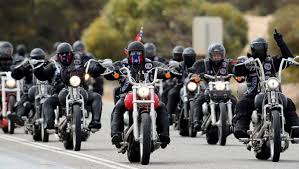
Free Will and Harley Guys

It would not be wise to piss off Harley guys.

However. If any happen to be reading this, they'll be the ones with a sense of humor.

We're counting on that.

Harley guys ride Harley Davidson bikes. Harleys (as in, the bikes) are all pretty different. You can get them built to your own specs. So that, you know, it's not like all the other Harleys.

And then you get dressed to ride your Harley. Then you ride off to meet with all the other Harley guys.

Might be your own little group from the local Harley hood. 

Might be Sturgis. Which is the annual mating grounds of Harley guys. Don't Google Sturgis. Disturbing pics.

Harley guys are fiercely individualistic. They set themselves apart from regular guys. They are fiercely different. They are not like anyone else. They stand alone. Fiercely.


Except.

They all kinda 

look alike.

So do their bikes.

They fiercely want to look different from all the other guys.

But not that different from, well,

Each other.

Because they want to belong to that group. They want to be a Harley guy. So they gotta ride a Harley and dress like a Harley guy.


Totally naked Harley chick.
Even gotta have a Harley chick on the back. And she's gotta dress (or not) like a Harley chick.

So here's a subculture that fiercely values free will. Individualism. Freedom. Liberty. The Right To Be Your Own Person.

As much or much more maybe than any other subculture in the world.

But that's gotta be balanced with the even more fierce desire to belong, to fit in, to look right, act right, dress right.

So. Are Harley guys fiercely acting out of free will, or are they just one more version of 

Pavlov's Dogs?

I'm gonna say this cuz I think it's pretty much true: the only people who are truly different from everyone else

tend to be certifiably nuts.


Because if normal people show up to their group of buds and they don't look like the rest of the buds, then the social pressure (as in, making serious fun of the idiotic way they look) is huge and they tend to show up next time fitting into the norms.

Even if they are all Harley guys.

Because. We all want to belong. To fit in. To be like the people we want to be like.

There are (I propose) two things in life that motivate us.

One. To belong. To be loved. To be a part of something that is greater than ourselves.

Two. To matter. To make a difference. To leave a mark. To leave the world a different (presumably better) place than it was. We want our lives to have a meaning and purpose.

And we will largely do whatever it takes to get those two things done.

Pavlov. Those are our stimuli. To be loved. To matter. And we will slobber with all the dogs to be loved and to matter.

There may be no free will about it. OK, maybe we choose which groups we want to be a part of, but I'm thinking that we are (mostly?)(completely?) influenced in that decision by the experiences we have.

For example. I have no desire to be a Harley guy or for my wife to be a Harley babe.


Not cool. Totally not cool.
But I love to ski. I'm really good. So I want to look like a really good skier. I want to dress like one. I want to have skiis and boots and even poles that really good skiers might have. I want to have a fine-looking ski jacket, and fine- looking goggles, and a cool helmet, and cool gloves, and even (this is true) cool skier long-underwear.

Now. If I have all of this cool gear and then I ski like a dork, well, that's not cool. Then I'm pretending to belong when I don't.

But I don't ski like a dork. So I get to belong. And my wife is a fine skier. So I have a beautiful ski wife. Awesome. It's the whole package. If I call her a beautiful ski babe or ski chick, I'm going to find one of my ski poles lodged in an uncomfortable place. So I'm not going to do that.

So here's the question. If life pulled a Tom Hanks "Cast Away" trick on me and I ended up alone with a volleyball in a deserted ski resort, would I still ski? Am I making a free will decision to ski, or am I doing it because I want to belong to cool skiers?

Aye. That's a good question.

Because the reasons that I am a skier are 1) my parents took me skiing in Colorado, and then 2) we moved to Switzerland when I was in high school, and 3) skiing was The Thing To Do in Winter in Switzerland, and we had a ski team and I was on it (briefly) and so 4) skiing is totally cool. To me, anyway.


Curling groupies. Clearly nobody would look like this
by making a free will decision to do so.
Curling to me is not cool. It's ridiculous. But to curlers, curling is awesome. There might even be curling groupies. Of course there are curling groupies. Clearly not a free will decision to be a curling groupie.

I'm fully convinced that curling was invented by drunk "people" (meaning drunk "guys") in the Far North who said to themselves one night, what can we do with ice, a big rock, and some brooms? And can we wear ridiculous pants, too? Awesome!

Anyway. So the question is, are ALL of our decisions caused by influences outside of ourselves, or just MOST of them? And if it's MOST, then where does free will actually start?

And the answer is...

Nobody really knows. 

So everybody just makes stuff up.

Wednesday, August 31, 2016

Free Will and Butterflies

The problem is, the universe is still pretty predictable. Like, clockwork.

And so are you.

We can predict lots of things the universe is going to do. Sunrises. Sunsets. Eclipses. Rainbows. Lots of things.

We can predict lots of things you're going to do. Given enough information. You'll eat. Sleep. Poop. Grow. Learn things.


But the other problem is, we can't predict everything. Most things. Lots of things. But not everything.

So we don't really know if you have a little bit of free will, or a lot, or almost none.

It's hard to tell.

There's this thing called Chaos Theory. It says that although the universe and nature and stuff are MOSTLY predictable, every now and then, things get really really unpredictable.
Butterflies. Trying to destroy the world.
Not very good at it yet.

It's called the Butterfly Effect. It says that sometimes, something as small as the flapping of a butterfly wing can set off a series of events that cause something HUGE to happen. Like a hurricane or a tornado.

Every now and then.

So mostly you are predictable (you and the universe), but every now and then,

You are really really unpredictable.

Does that mean you have free will?

Ah. No. Not completely.

It says that just because we didn't know what made you do whatever weird, bizarre, possibly illegal and immoral thing that you did, there could have been something that made you do it.

So although it's possible for you to have free will, we still don't know if you actually have it.

What there is, is the possibility for free will to exist.

Because the universe is not completely deterministic, thanks to quantum things and chaotic things, it's possible for you to have free will.

It's clearly not predetermined that you have free will.

Ouch. That's confusing.

Because here's the thing. Most of the time, we act like we have free will, but whether or not we are actually making free will decisions is hard to say.

Mostly, we don't.


That is, we are little puppies slobbering when the bell rings.

You know. Pavlov's Dogs. All of that. That's when this guy named Pavlov (great name for a Star Trek character) trained a bunch of dogs to salivate when they heard a bell ring by ringing a bell and feeding them doggy vittles.

After awhile, all he had to do was ring the bell, and looky there! Doggy slobber. Even without vittles. After another while, eventually one would guess that the doggies would figure out that they weren't getting any snacks and stop slobbering.

We're like the dogs. We are (largely?)(totally?)(that's the problem - don't really know) influenced by cultural bells.

We are (largely?)(totally?) influenced by our culture. By our friends. Magazines. Movies. TV shows. Celebrities. Families.

We dress the way we dress, cut our hair, decorate our homes, buy the things we buy, read the things we read, listen to and watch what we listen to and watch because of the little bubbles that we live in.

Our hearts also beat and our lungs breathe and our entire bodies work constantly without us making any decisions about any of it.

That's a good thing. If we had to constantly think about keeping our hearts beating and our lungs breathing and our spleens spleening, we'd die at night.

A lot of the things we do when we're awake and asleep, we do on autopilot. We don't think much about it. We have trained ourselves to walk, talk, drive, run, jump, eat, and do all the things we do without thinking about them very much.

And that's a good thing.

But the question is, are we (largely?)(totally?) controlled by our autopilots? What are the decisions that we make? Are (none?)(some?)(any?)(all?) of them free will decisions?

Turns out, it's really hard to tell.

Behavioralist BF Skinner said that none of them are. He called it "conditioned responses". Everything we do, we do because we have been trained or conditioned to do so. Even, apparently, become famous behavioralists.

I think that's a bit of a stretch.


But it's really hard to tell where free will actually starts, since we are so heavily (completely?) influenced by outside factors, outside of our ability even to be aware that it's happening. We are truly conditioned to do most things.

The question is, are there things that we do outside of conditioning? As free will decisions?

And the answer is ...

You have the potential to do things that you are not conditioned to do.

Whether or not you actually ever do that, is the question.

And the answer is, maybe, every now and then. Like a hostile butterfly. 

Maybe, every now and then, we do something unpredictable. We make a free will decision. Maybe.

Wednesday, August 17, 2016

Free Will is Back. Sort of.

So. Do we have free will, and does God exist?

Well, if you're going to get rid of them again, you're gonna have to have a darn good reason. Better than, I DON'T THINK SO! That's so lame.

Let's talk about it for a minute.

If you are someone who doesn't believe in free will (and feel free, btw), then you could be accused of not thinking clearly about it.

Because if you are also (as there is an excellent chance) a person who detests religion and all this God talk, then you are not making any sense.


Because (you know where this is going, don't you?) if there's no free will, then all of the religious people have no choice but to be religious. All caps warning. It's not their fault. I changed my mind about the all caps. You gotta lay off. Stop hassling them. The particles made them religious, ultimately.

And you, btw, are irreligious, atheist, agnostic, and/or skeptical not because you are so smart. You have no choice. The particles made you that way. Lucky you.


None of us get to claim any credit or take any blame for our looks, brains, success, talent, skills, experience, hard work, money, possessions, achievements, or anything. For our failures, shortcomings, flaws, zits, flatulence, body odor, obesity, baldness, bad posture, terrible grades, lousiness at sports, friendlessness, ugliness, or anything.

So if you or anyone are taking any credit or blame for anything and if you don't believe in free will, then you are no less an idiot than religious people.

Actually, to be totally precise, none of you are idiots. If free will does not exist. You only have the capacity to be an idiot if free will exists.


So if you think religious people are idiots, or if you think atheists are idiots, or if you think anybody anywhere for any reason at any time is an idiot, then, really, the only way for that to be true is if

(you know where this is going, don't you?)

Free will exists. And by extension, God might also exist.

WTH?, you might exclaim with some heat and passion. H, to remind you, is Heck, because crapload is our swearing limit. It's like a law of physics.


Newton. Not Newman. Pay attention.
Because, we reiterate, the smart guys used the deterministic infinite universe to get rid of both Free Will and God. And the most recent group of smart guys have not been able (or motivated) to update that. Atheists are Newtonians all. I'm so embarrassed for them. You. Whatever. You're still using a Newtonian universe to get rid of God, unbeknownst to you. You also think that God doesn't exist because religious people are idiots, which, I remind you, is only true if Free Will exists, and if Free Will exists, then so does God. It's like Catch-22, which I should not admit is my favorite book of all time.

Major Major Major Major. I just had to say that.

You should be nicer to idiots, btw. If free will doesn't exist. 

If it does, then, well, they're idiots. Still. Better to be nice. There's that naughtiness thing lurking out there somewhere. Plus, we are each an idiot about something. Einstein said that. Paraphrased.


Symmetry. By Da Vinci as a child.
Summing up. The only way that religious people are idiots is if free will exists, and if free will exists, then (it is highly likely) God exists.

So summing up again. The only way that religious people are idiots is if God exists.

That's some nice symmetry.

So if free will does not exist, then you can't be an idiot (nobody can) and nothing is your fault and making fun of idiots or someone else's beliefs is not a fully informed thing to do. Though, of course, if there is no free will, then making fun of others is not your fault.

Yeah. See. Nobody lives like that.

We completely and totally act like people actually are idiots and things are someone's fault, otherwise nobody could ever go to jail for doing anything wrong or evil, and in fact, evil would not exist. Good, neither. There would be no good or evil, because for you to do something evil or something good would take a free will decision on your part, which you could not do if free will doesn't exist. The particles made you do it.

So we all spend all of our time acting like we all have free will. Even the scientists who think we don't have free will, act like they have free will.

Weird.


Free Will. Not Free Willy.
Pay attention.
That doesn't mean we have free will, though.

There's this Newtonian concept called Determinism, and another one called Mechanism. They are the problem.

Determinism says that everything is predetermined by things that happened already. Again, it's all about the particles.

Mechanism says that, because of the laws of physics, everything acts like a machine, and what a machine is, is predictable. Everything happens the same way that it has always happened, so we can predict what's going to happen.

So the laws tell the particles what to do, whether they are single particles or a galaxy made of particles, and the particles do just that.

And since you are made of particles, theoretically we can look at the way you have ever done anything and predict what you will do next.

There you go. No free will. Even in a universe with a starting point.

Since we still have to answer the question of where the laws and the universe came from, God is still theoretically around even if free will is not.

But.

This is all Newtonian. That's not the universe we live in. Well, it is, in part, but only the dull and boring and predictable parts.

It's really a Quantum thing.

It's pretty simple.

The Newtonian thing says, if you know everything about the particles (where they are, how fast they're going, stuff like that), then you can predict where they will go and what happens when they get there.

And you lose your free will. Because you are made of particles.

But the Quantum thing says (wait for it), 

you cannot know everything about the particles. Any particle. Not even one.

It's called Quantum Uncertainty. You can't know where they are, or if they are, or where they're going, or if they're going.

And since we can't predict what the particles are going to do, and you are made of particles, then theoretically we can't predict what you are going to do.


And now. Theoretically. You get your free will back.

We're not really sure what that means, of course.


That's the problem.

Wednesday, August 3, 2016

A Brief History of Free Will

And punctuation mistakes. Making that up, too.
Rather than doing actual research, I'm just going to make this up.

If free will exists, then I get to do that. Make this up, that is.

If free will does not exist, then I apparently have no choice but to just make it up.

So. It always felt a lot like we had free will when we still thought we had free will. I mean, there was no question. Right or left. Up or down. Do a bad thing, don't do a bad thing. Or a good thing. Eat this, don't eat that. Go here, go there. 

My brain (speaking metaphorically about all brains) felt very much as though it was faced with decisions all the time and got to make up its own mind, since it was, in fact, a mind.

But then Newton came along and discovered that the universe worked according to laws and rules and regulations. All the time. Never stopped. Never took time off for a vacay. No coffee breaks or weekends at the beach.

And this meant that everything worked according to the laws. All the time.

And the laws had always been there. Since the universe was infinitely old and large and all of that.

You and me and everything and everyone are made of tiny little particles that work according to the laws. All the time.

Pretty soon, some smart guys said to themselves, huh. THAT'S interesting.

Because what that means is that since our brains are made of little particles that work according to the rules all the time, then ...


What we THINK is a free will decision is actually just something that the particles did. The laws had been working forever, making all the particles in the universe do stuff, and eventually, some of the particles ended up in my brain making me say something stupid to this really hot girl in high school instead of something smooth and smart and urbane and debonair which would have in turn made all of her brain particles want to run off with me and pursue connubial bliss and live happily ever after.

So. All caps coming.

IT'S NOT MY FAULT!

Good to know. Sort of.

To review. Since the universe has always been there and the laws have always been there, then there's no free will. Ever. Never. Not possible. Not gonna happen.

And oh btw, we also don't need God to explain how things work, since the laws make everything work and the laws had always been there so we didn't need God to start the game, get the ball rolling, blow the whistle, wave the flag. The game was eternal, had always been the game.

So the smart guys said to themselves, huh. Sweet. No God. So we can do whatever we want. And no free will. So it's not our fault. The particles made me do it. Niiiiice.

There was one tiny little teensy weensy hardly-worth-mentioning problem.

Ahem. The universe had not always been there. Neither had the laws. Everything had a starting point.

Damn.

Here's where we are, then.

We THOUGHT we didn't have free will because the universe was infinitely large and old and the laws had always been there making us do things that we THOUGHT was free will but wasn't and history was an infinitely long string of laws making particles do stuff that included all the stuff that we were each doing that we THOUGHT was stuff we decided to do but didn't really.

But this was entirely totally absolutely dependent on the universe and the laws being infinitely old.

But. They aren't.

Which means that the universe and the laws used to not be here. At all.


So since we used the infinite universe to get rid of both God and free will, then since the universe isn't infinite, then the possibility that both God and free will exist, um, exists. It's possible. Not definite. But definitely possible.

You probably didn't know that's how we got rid of both God and free will. 'Tis, though. We sorta forgot that.

Then when Big Bang showed up (thanks, Albert), all of sudden things got complicated. Science didn't even like Big Bang (Albert didn't even like Big Bang) because it meant that we would have to start talking about God and religion and going to church or temple or mosque or Mecca or Jerusalem or Rome or Tokyo (Tokyo?) and cleaning up our acts naughtiness-wise and

nobody really wanted to do that.

But it all worked out because religious people didn't like Big Bang either because (science was right) they're idiots. With apologies to religious people. OK, not really.


In fairness to religious people, we should probably mention why they didn't like Big Bang. They believe that God instantaneously created the universe out of nothing, but Big Bang Theory says that the universe suddenly popped into being out of nothing.

You can see the problem.

Yeah, me neither. I just don't get it.

Anyway. So. Free will might be back. That's not the movie about the whale, btw. Which, btw, my British friends think the title of which is hysterical.


To sum up. Free will (and God) went away because of the infinite universe, and they came back maybe because it's not infinite. Time-wise, that is. Space-wise, we'll never know.

And I'm out of time. But not space. Ha. Hysterical.